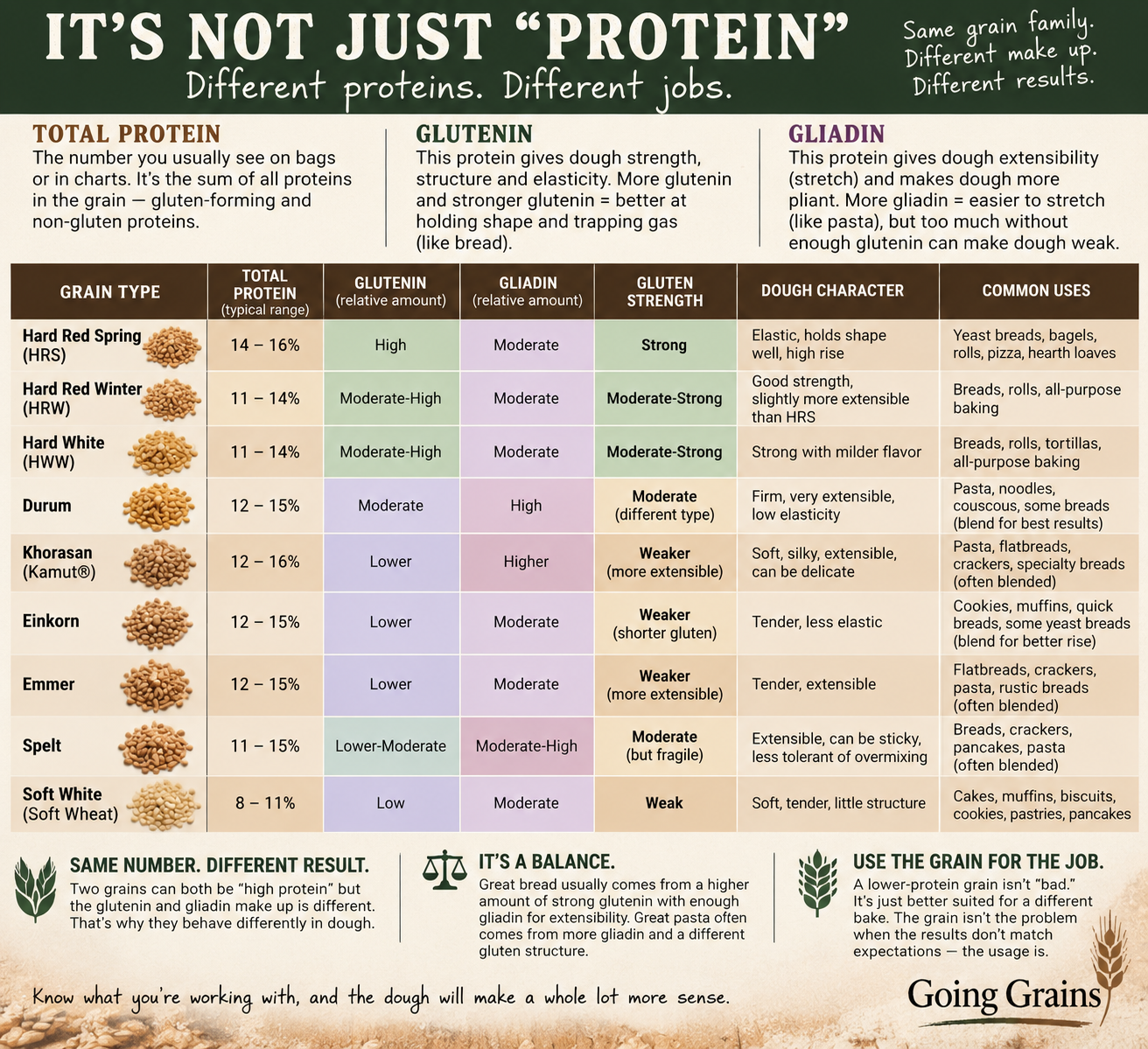
Grain Types Are Not As Simple As The Chart Makes Them Look
Every time I see a grain chart, I understand why beginners get confused.
Hard.
Soft.
Ancient.
High protein.
Low protein.
Bread grain.
Pasta grain.
Nice little boxes.
Problem is… the grain does not care about the box. It also doesn’t give 2 pennies about what scientists say is high protein.
A grain can be listed as “high protein,” but the number being reported is total protein. It does not tell you how much of that protein is actually contributing to strong gluten, nor does it tell you how those gluten-forming proteins behave together.
That matters.
Gluten strength depends heavily on the gluten-forming proteins — mainly glutenin and gliadin — and their balance and quality.
So two grains can both be called “high protein” and behave NOTHING alike in dough.
Hard red spring can give you strong, elastic bread dough.
Khorasan can also carry a respectable protein number, but it does not behave like hard red spring.
Durum is another good example. Hard kernel? Absolutely. Great for pasta? Yep. Automatically the strongest bread grain because somebody called it high protein? Nope.
And soft wheat is not “bad” because it has less protein. It is doing a different job.
That is why I hate seeing grain choice reduced to one protein number or one word like “hard.”
Protein quantity is only part of the story.
We need to really start teaching that glutenin and gliadin are completely different proteins that are added together to get the protein number.
Glutenin is your strength, gliadin is your stretch. If you don’t know which one is counting for the higher part of that protein count, how you suppose to understand how to use the grain?
And guess what… those 2 aren’t even the ONLY 2 counted. So now you’re really messing with beginners when you throw out numbers claiming higher protein creates better bread and lower protein creates better cakes…. how about let’s be honest and give what they ACTUALLY have.
Here’s a great start… enjoy!