
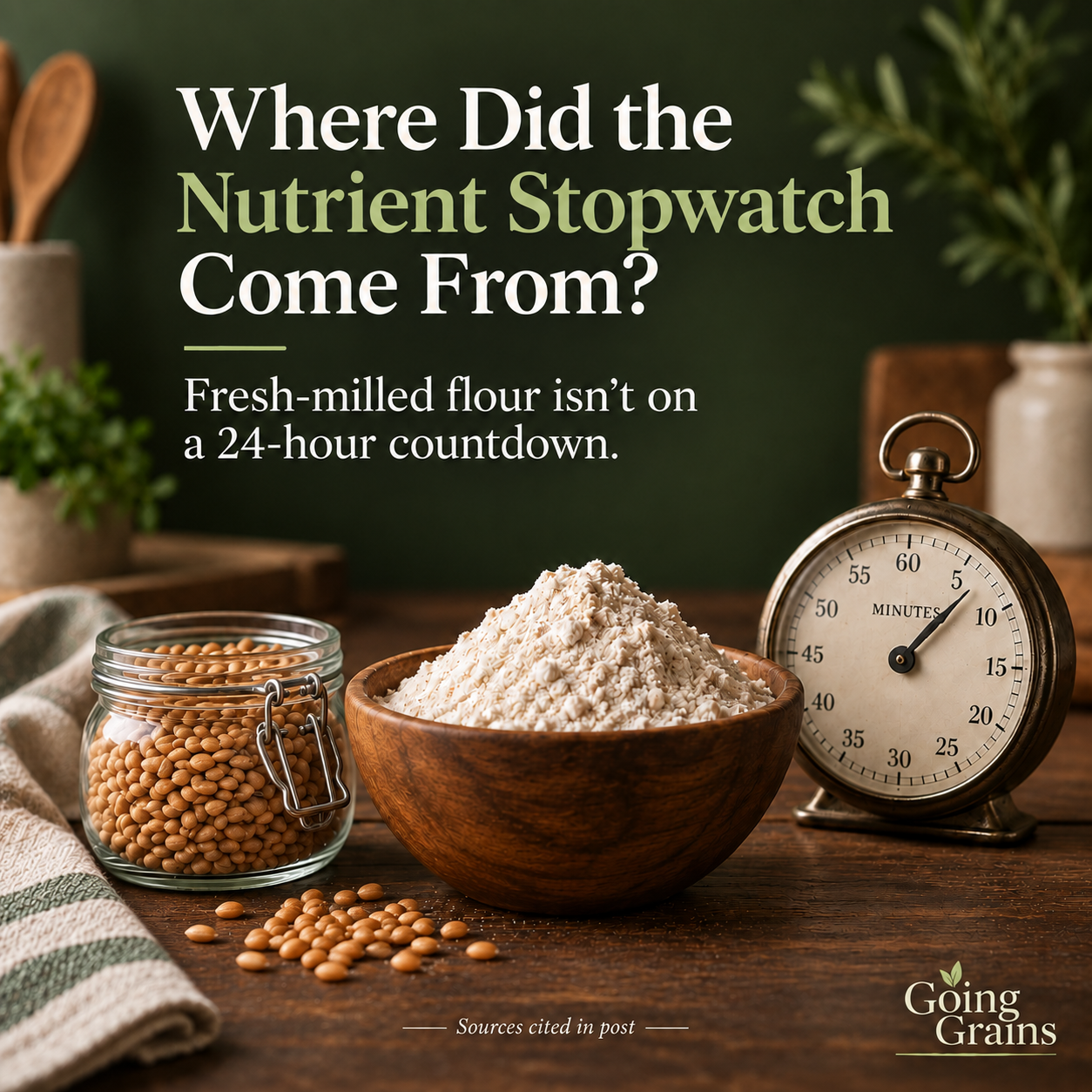
Where Did The Nutrient Stop Watch Come From?
Y’all… I have spent entirely too much time trying to find the stopwatch somebody apparently put on a bowl of flour. 🤣
Because if you’ve been around fresh-milled flour for more than five minutes, you’ve probably heard some version of this:
“Fresh-milled flour loses 40–45% of its nutrients within 24 hours.”
Then:
“By 72 hours, 90% of the nutrients are gone.”
Those numbers are EVERYWHERE.
So I went looking for the study behind them.
And then I kept looking.
And looking.
And somewhere along the way Susan and I started wondering if perhaps the original research had been buried with Jimmy Hoffa. 😭
Because here’s what I CAN find.
Oxidation after milling is real.
Whole-wheat flour absolutely changes during storage. The bran and germ bring oils, enzymes, vitamins and antioxidants into the flour that refined white flour does not contain in the same amounts. Once the grain is broken open, those components are exposed to conditions they weren’t exposed to inside an intact kernel.
Nobody is arguing with that.
What I cannot find is credible research showing that “40–45% of the nutrients” disappear within 24 hours and “90%” disappear within 72.
And there’s another problem with that sentence before we even get to the percentages.
What nutrients?
Vitamin E?
Thiamin?
Iron?
Zinc?
Protein?
Minerals?
Essential fatty acids?
Antioxidants?
Those things do not all behave the same way during storage.
“Nutrients” is not one substance with a fuel gauge attached to it. 🤣
One published study followed vitamin E in wheat flour and whole-wheat flour for 297 DAYS.
Not 24 hours.
Not 72 hours.
Two hundred ninety-seven days.
In the whole-wheat flour, total vitamin E loss after those 297 days was about 32%.
Another review of whole-wheat flour storage reported the same research and also cited thiamin losses of only about 7.2–11.5% after TWELVE MONTHS under different storage conditions.
Now does that mean flour stays exactly the same forever?
Absolutely not.
Whole-wheat flour has a shorter shelf life than refined flour largely because of what happens to its lipids. Lipase begins breaking fats down, oxidation can follow, flavor changes, flour functionality changes, and some nutritional components decline.
Storage temperature matters.
Moisture matters.
Oxygen matters.
Time matters.
The particular nutrient you’re measuring matters.
But that is a LONG way from:
“Your flour lost almost half its nutrition before tomorrow morning.”
And honestly, I think the truth is more interesting anyway.
Fresh-milled flour doesn’t need an exaggerated countdown clock to make it valuable.
You milled the WHOLE grain.
You still have the bran.
You still have the germ.
You still have the endosperm.
You didn’t remove part of the kernel and then try to replace a handful of things afterward.
That alone is worth talking about.
So yes, I still mill close to when I bake….sometimes…
I like the flavor.
I like the freshness.
I like knowing exactly what went into my flour.
But I’m not going to tell somebody their flour becomes nutritionally useless because it sat on the counter for three days when I cannot find evidence supporting that claim.
If we’re going to teach people WHY fresh-milled flour is worth using…
we don’t need borrowed numbers nobody can trace.
The grain can stand on its own.
Sources:
Nielsen, M.M. & Hansen, Å. (2008). “Stability of Vitamin E in Wheat Flour and Whole Wheat Flour During Storage.” Cereal Chemistry, 85(6), 716–720. DOI: 10.1094/CCHEM-85-6-0716. The study followed vitamin E for 297 days and reported about a 32% total loss in whole-wheat flour over that period.
Doblado-Maldonado, A.F., Pike, O.A., Sweley, J.C., & Rose, D.J. (2012). “Key issues and challenges in whole wheat flour milling and storage.” Journal of Cereal Science, 56(2), 119–126. DOI: 10.1016/j.jcs.2012.02.015. The review discusses lipid degradation as the major storage problem in whole-wheat flour and reports published findings on vitamin E and thiamin losses over periods measured in months, not hours.